Nobody puts day four on Instagram. That is the day people panic, call the clinic, and far too often start pulling at their own face. Here is the entire fourteen days, written by the nurse who will be answering your phone call.
On this page
- Why the timeline matters more than the peel
- Day 0, the appointment
- Days 1 and 2, tight, bronze, nothing happening
- Days 3 and 4, the part nobody warns you about
- Days 5 to 7, sheet shedding
- Days 7 to 10, new skin and why it burns
- Weeks 2 to 4, the pink fades
- Months 1 to 6, the result you actually paid for
- If your skin is deeper than Fitzpatrick IV
- Five things that go wrong, and how not to do them
- Questions we get asked at 9pm on day four
Why the timeline matters more than the peel
Here is something the aesthetics industry does not like to say out loud: the treatment is about fifteen minutes long, and the outcome is decided almost entirely by the two weeks afterwards.
We can select the perfect depth for your skin type, watch the frosting endpoint with total precision, and hand you a flawless result. Then you can undo it in about four seconds on day four by pulling at a piece of skin that wasn't ready to come off. That single act is the most common cause of a mark that outlasts the treatment. Not the acid. Not the concentration. A fingernail.
So this article exists for one reason. If you know exactly what day four looks like before you book, day four is uneventful. If you don't, day four is a crisis. That's the whole difference.
The timings below describe a medium depth peel, what we call a Level 2 or Level 3 at Mirror. A Level 1 peel follows the same curve at a much quieter volume: fine flaking around days two to four that most people cover completely. The full depth ladder is here.
Day 0, the appointment
You arrive with a bare face. We cleanse and then degrease the skin with a solvent. This step feels pointless and is not. Residual oil makes the acid penetrate unevenly, which is how you get a patchy result.
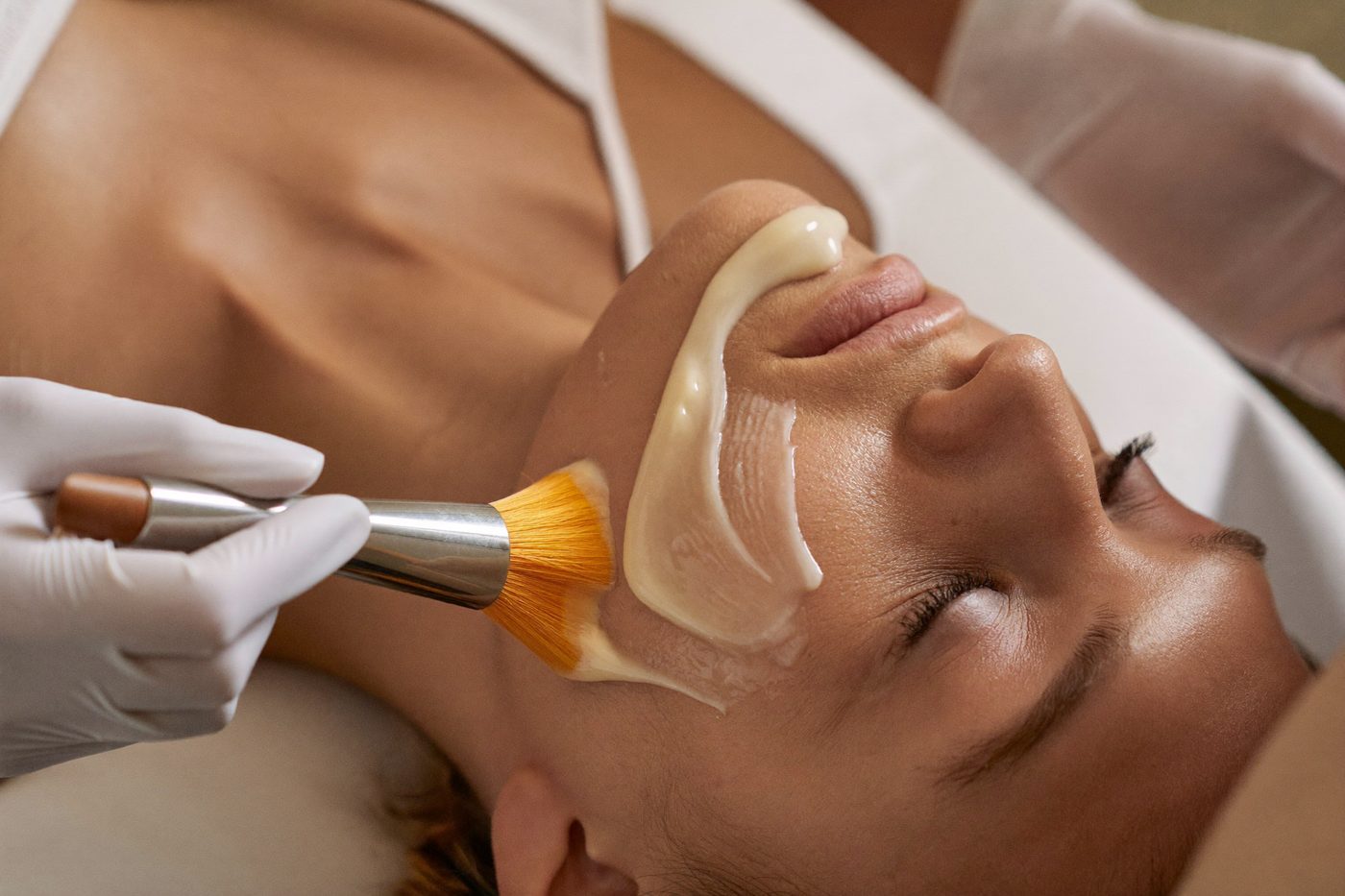
The acid goes on in layers with a gauze or a brush, section by section. Within about thirty to sixty seconds of each layer there's a sharp stinging or burning that builds, plateaus, then fades. A cool air fan handles it. Most people describe a medium peel as very tolerable. Nobody enjoys it.
Then we watch for frosting, a white blush that appears where the acid has coagulated protein in the upper skin. Frosting is not a side effect. It is the measurement. It tells the clinician, in real time, exactly how deep the treatment has reached, and it is the reason a medical peel is a clinical procedure rather than a spa service. Someone who cannot read a frosting endpoint should not be holding the acid.
Total time in the room is around thirty minutes. You leave looking flushed, like a brisk walk in cold wind, or a mild sunburn. Most people go back to work that afternoon. You will look completely normal to anyone who sees you on day zero, which is precisely why the next stage catches people off guard.
Days 1 and 2, tight, bronze, and apparently nothing happening
The redness settles and is replaced by a bronze or slightly leathery cast, as if you have a tan that doesn't quite belong to you. The dominant sensation is tightness. People describe it as wearing a mask a size too small, or as skin that feels like it's been starched.
There is almost no peeling yet. This is the stage where clients message us to ask whether the peel worked.
It worked. What you're feeling is the treated layer dehydrating and preparing to separate. The shedding hasn't started because the skin underneath isn't ready to be exposed. Nothing about this phase requires intervention beyond gentle cleansing, a bland barrier balm, and sunscreen.
What to do: lukewarm water, fingertips only, no washcloth. Balm as often as it feels tight. Sleep on a clean pillowcase. Drink water.
What not to do: exfoliate anything. Apply a "hydrating acid." Book a facial. Investigate the tightness with your fingernails.
Days 3 and 4, the part nobody warns you about
This is the day the peel earns its reputation.
Cracking begins where the skin moves most, around the nostrils and the corners of the mouth, then spreads outward across the cheeks. The surface fissures into a fine crazed pattern. Some areas lift at the edges while others stay stubbornly attached. Your face does not look elegant. It looks like it is coming apart, because it is.
Do not pull anything. Not a corner, not an edge, not the piece that is obviously ready. Skin lifted before it releases on its own takes living tissue with it, and that is how you get a raw patch that heals into a mark you'll still be looking at in three months. If a piece is hanging and driving you mad, small clean scissors, flush to the skin, and nothing more.
This is also the peak of the visual downtime. If you have any control over your calendar, this is the pair of days to spend at home. Most people schedule the treatment on a Wednesday or Thursday so that days three and four land on a weekend.
What to do: balm generously and often. Occluded skin peels more evenly and looks dramatically less alarming. Hats. Stay out of the sun entirely. Keep your hands off your face, which is harder than it sounds because the itching is real.
Days 5 to 7, sheet shedding
The character of the peeling changes. Instead of flaking, skin now comes away in sheets, larger pieces that release cleanly when they're ready, usually in the shower or when you dry your face.
The relief is immediate. For the first time, what's underneath is visible, and it is bright, smooth and unmistakably new.
Makeup can usually go back on once the surface is intact and no longer actively lifting. For most people that's day six or seven. Use something forgiving and hydrating rather than a matte long wear formula, which will cling to any remaining texture and make it more obvious, not less.
What to do: let pieces come away on their own. Keep the balm going. Start reintroducing your gentle cleanser.
What not to do: retinoids, acids, vitamin C, scrubs, cleansing brushes, saunas, hot yoga, or any workout that leaves your face genuinely hot. Heat during healing is the shortest route to uneven pigment.
Days 7 to 10, new skin, and why it burns
Peeling is finished. What you're looking at is bright, even, slightly pink skin with a quality of light reflection that is difficult to fake.
It is also, in a very literal sense, brand new. The stratum corneum has been replaced and the barrier is still assembling. New skin burns in a fraction of the time old skin does. Ten minutes in a car with the sun through the side window is enough to undo weeks of work.
Broad spectrum SPF 30 or higher, every single morning, without exceptions and without negotiation. This is not a general skincare recommendation. During this window it is part of the treatment, and skipping it is the difference between an even result and a patchy one.
Actives stay out until we clear you, usually around the two week mark, and reintroduced one product at a time so that if something stings we know which one it was.
Weeks 2 to 4, the pink fades
The pinkness normalises. Tone reads visibly more even, the brown patches you came in about are lighter, and the ones that were going to need more than one session are now clearly identifiable, which is useful information for planning the next one.
This is typically the window in which somebody asks whether you've been away, or changed something, and can't quite say what.
It is also, usefully, the point at which we can assess how your skin actually healed and decide whether the next session steps up a level or holds where it is. That decision is made from evidence, not from a package sold in advance.
Months 1 to 6, the result you actually paid for
Here is the most misunderstood part of the whole process: the result at week two is not the result.
The visible shedding is only the surface half of what a peel does. Underneath, the controlled injury has triggered a wound healing cascade that lays down new collagen over a period of months. Firmness, fine line softening and the deeper improvement in tone continue accumulating for up to half a year after a single session.
This is precisely why we space sessions four to six weeks apart rather than stacking them, and why a course of three peels done properly outperforms one aggressive peel done heroically. You are not buying an event. You are buying a curve.
If your skin is deeper than Fitzpatrick IV
The recovery curve is the same. The preparation is not, and this is the section most clinic websites in the GTA simply don't write.
Melanin rich skin has the same number of pigment producing cells as fair skin. Those cells are just more reactive. Injure them and they respond by making pigment. That's post inflammatory hyperpigmentation, and it is the only complication in this treatment that genuinely matters.
PIH is not caused by the peel. It is caused by the peel that skipped the preparation. So the sequence changes:
- Two to four weeks of priming with a tyrosinase inhibiting regimen before any acid touches your face, so the pigment pathway is already suppressed when the injury arrives.
- A deliberately light first session, Level 1 regardless of what you came in for. Not because deeper skin can't tolerate more, but because nobody can predict how your skin answers until it has answered once.
- Escalation based on evidence. We look at how you healed at week two and step up from there. Most melanin rich skin reaches a medium depth comfortably. It just shouldn't start there.
- Aftercare held to the letter. Deeper skin tones win or lose this treatment in the two weeks afterwards, and sun exposure during healing is the single biggest variable.
If a clinic has never mentioned priming to you, they aren't being conservative about your skin. They have simply never had to think about it.
Five things that go wrong, and how not to do them
- Pulling skin on day three or four. The single most common cause of a lasting mark. Wait, or use small clean scissors flush to the surface.
- Sun exposure during week one. New skin has no defences. A patio lunch on day eight can cost you the evenness you just bought.
- Restarting retinol too early. "It felt fine" is not clearance. Two weeks, then one product at a time.
- Booking a peel inside four weeks of a wedding or a shoot. Depending where you land in the curve, you can be mid shed on the day. If the date is fixed, do something hydrating now and peel afterwards.
- Not telling your clinician about isotretinoin. If you've taken it in the last six months, peels wait. This one isn't a preference, it's a safety rule, and we can only follow it if you tell us.
Questions we get asked at 9pm on day four
My face is not peeling at all. Did it not work?
Almost certainly it worked. Peeling generally starts on day three, and days one and two feel tight and look bronze with very little shedding. Some people also shed lightly and briefly, particularly at lighter depths. The depth of the treatment matters far more than the volume of visible skin.
There is a piece hanging off. Can I just trim it?
Yes. Small clean scissors, cut flush to the skin, and nothing else. Do not pull, and do not chase the edge. Anything that does not release on its own is not ready.
When can I wear makeup?
Once the surface is intact and nothing is actively lifting, which is usually day six or seven. Choose a hydrating, forgiving formula rather than matte long wear, which clings to residual texture.
How long until I look normal in photographs?
Day seven to ten for most people after a medium peel. Peeling is done and the skin is bright, though still pink. Fully settled colour is closer to two weeks. A Level 1 peel is photograph safe throughout.
Can I exercise?
Walking, yes. Anything that makes your face genuinely hot, running, hot yoga, saunas, steam rooms, waits until peeling is finished, generally day seven. Heat during healing drives pigment.
It is itchy and I am going insane. Is that normal?
Very. Itching peaks around days three to five as the skin separates. Balm applied frequently is the answer. Scratching is not. If itching comes with spreading redness, warmth, swelling or pus, that is not itch. Call us, because it may be an infection or a herpes reactivation and both are treatable quickly.
When can I have my next one?
Four to six weeks for a medium peel, two to three weeks at Level 1, and six to eight weeks for focal scar work. The gap is not administrative. Collagen remodelling is still underway, and stacking sessions raises risk without improving the outcome.
Can I have a peel while I am having wrinkle relaxers or filler?
Yes, with sequencing. We separate a peel from an injectable appointment by about two weeks in either direction so we are never assessing swelling and healing at the same time.
The day by day is easier when someone is on the other end of the phone
Every peel at Mirror is assessed and performed by a licensed nurse, and every client leaves with a printed day by day card, an aftercare plan and a number to call. Your first appointment is a skin assessment, not a peel. The $100 fee applies to your treatment.
Book Your Peel Consult