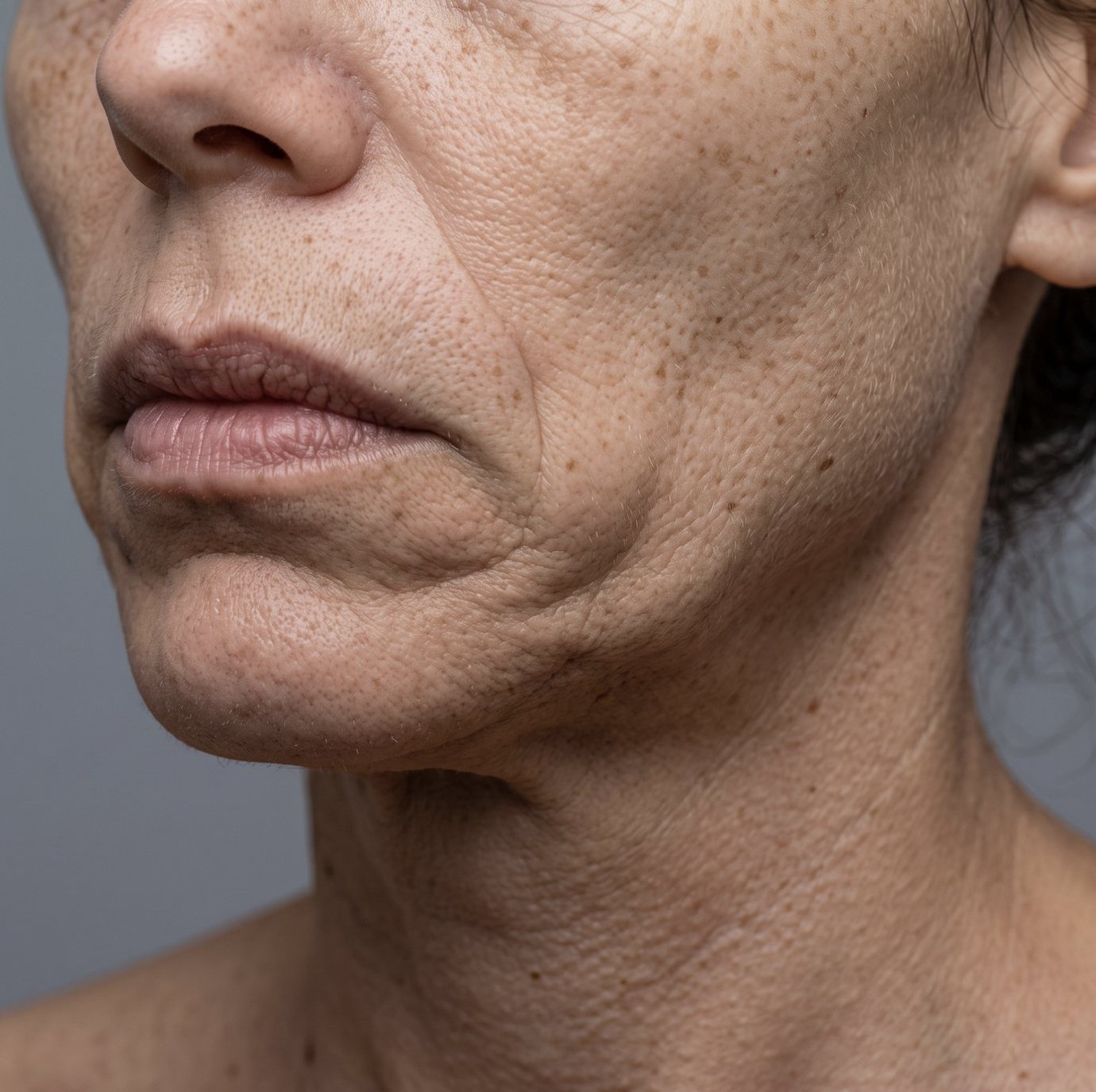
You lost the weight. Your bloodwork is the best it has been in years. And the face in the mirror looks ten years older than it did before you started. Nobody warned you about that part, so here is the honest version, written by a nurse.
On this page
- What Ozempic face actually is
- Why the face pays for rapid weight loss
- Who gets it, and who mostly does not
- Why filler alone is usually the wrong first move
- How we rebuild a deflated face, in order
- Still losing weight? Read this before treating anything
- What this costs, honestly
- Questions we hear every week
What Ozempic face actually is
Ozempic face is not a medical diagnosis. It is the nickname that stuck for what a face looks like after rapid, significant weight loss: hollowed temples and cheeks, deeper folds around the nose and mouth, loose skin along the jaw, and a tired, drawn look that no amount of sleep fixes. The name comes from one brand of GLP-1 medication, but the same thing happens with any of them, and with bariatric surgery, and with any fast weight loss at all. The drug is not doing anything special to your face. The speed of the loss is.
Fat is not the enemy in a face. Fat is the architecture. The soft, lifted, rested look of a younger face is mostly small compartments of fat sitting exactly where they should, supported by bone and wrapped in skin with good recoil. Weight loss medication cannot tell the difference between the fat you wanted gone and the fat that was holding your cheeks up. It takes both.
Why the face pays for rapid weight loss
Recent clinical work on medical weight loss and the face describes changes on several layers at once, and this matches exactly what we see in clinic. Four things happen together.
The superficial fat compartments deflate. The midface loses its convexity, so light stops reflecting off the cheek the way it used to. Contours flatten and the transition lines between facial zones become visible.
Deep support goes with it. The deeper fat pads that act as scaffolding shrink too, so everything above them settles lower. This is why folds around the nose and mouth suddenly deepen. The tissue is not sagging because it aged. It is sagging because the shelf underneath it left.
Skin quality drops. Rapid loss outpaces the skin's ability to retract. Collagen and elastin were already declining with age; now the skin is asked to shrink around a smaller face and it cannot keep up. The result is laxity, crepiness and that slightly empty, deflated texture.
It shows in the face first. You can hide a deflated arm in a sleeve. The face is where everyone, including you, notices weight loss speed. People routinely tell us their friends asked if they were unwell in the same month their doctor congratulated them on their bloodwork.
Who gets it, and who mostly does not
The pattern we see is consistent. It depends on how much you lose, how fast you lose it, and how old you are while it happens. Losing a large amount quickly in your forties or fifties, when collagen reserves are already lower, produces the strongest version. A slower loss in your late twenties often barely shows. Genetics, sun history and smoking all move the needle too.
If you are on a GLP-1 medication now and worried about this, the single most protective thing you can do costs nothing: lose slower if your prescriber agrees it is appropriate, keep your protein intake serious, and stay ahead of hydration. The face tolerates a gradual change far better than a cliff.
Why filler alone is usually the wrong first move
The instinct is obvious: the face lost volume, so put volume back. And when someone walks in asking for six syringes of filler, a busy clinic can simply sell them six syringes of filler.
Here is the problem. Ozempic face is not just missing volume. It is missing volume plus weakened support plus skin that has lost quality. Pour filler into a face with lax, thinned skin and poor scaffolding and you get weight without structure. That is how people end up looking puffy instead of restored, and it is where the fear of looking overdone comes from. The fear is justified. The technique it is reacting to is just wrong.
The clinical literature on medical weight loss faces points the same direction we do: rebuild quality and structure first, then place volume selectively.
How we rebuild a deflated face, in order
At Mirror every one of these starts with the same appointment: a full facial assessment, because the right sequence depends on your anatomy, your age, and how much you lost. This is the ladder we work through.
Step one, biostimulators. Sculptra and Radiesse do not fill the face. They signal your own fibroblasts to build new collagen over two to three months. For a post weight loss face this is usually the foundation, because it restores the tissue quality that everything else sits on. Results build gradually, which is exactly what you want. We wrote a full guide to Sculptra after weight loss if this is your starting point. Nobody at work says "what did you do." They say you look well.
Step two, structural filler, placed sparingly. Once the canvas is rebuilding, dermal filler goes where structure is genuinely missing: deep support points at the cheekbone, the chin, the jawline. This is facial balancing, not spot filling a line because the line is what you noticed.
Step three, skin quality on top. Depending on your skin, we layer polynucleotides for hydration and elasticity, PRP or PRF to use your own biology for regeneration, or microneedling for texture and firmness. These treat the crepey, deflated skin surface that filler cannot touch.
Not every face needs every step. Some people need only a biostimulator series. Some need two syringes of structural filler and nothing else. The assessment exists so you buy the treatment your face needs, in the order it needs it, and skip the rest.
Still losing weight? Read this before treating anything
If you are mid journey on a GLP-1, the honest advice is that timing matters more than enthusiasm. Volume placed into a face that is still shrinking is volume you paid for twice, because the plan changes underneath it. What we typically do instead is start collagen banking early, with biostimulators or regenerative skin treatments during the loss, then place any structural filler once your weight has been stable for roughly three months. That sequencing conversation is exactly what the consultation is for.
One more thing, because it belongs in the open: Mirror also runs a medically supervised weight management program led by Erika, our Nurse Practitioner. If you are losing weight with us, your face and your weight plan are managed under the same roof, and the sequencing takes care of itself. If you are prescribed elsewhere, we simply coordinate around your prescriber's plan. We will never adjust your medication, and we will never tell you to. That is between you and your prescriber.
What this costs, honestly
Published, because you should not have to book an appointment to learn a price. A facial assessment is $100, credited toward any treatment you book within 30 days. Biostimulators start around $750 to $900 per session depending on product, and most post weight loss faces plan two to three sessions. Structural filler runs $650 to $800 and up per syringe, and a restrained plan uses fewer syringes than you fear. Skin quality treatments vary by modality, and we quote the full sequence in writing at your consultation, before anything is booked.
What we will not do is quote your face from a blog post. The range above is what honest planning looks like. The exact number comes from an assessment.
Questions we hear every week
Does Ozempic face go away on its own?
Partially, sometimes. Skin keeps retracting slowly for months after weight stabilises, and younger skin retracts more. The lost fat compartments do not refill unless you regain the weight, which is nobody's plan. If the hollowing bothers you at month three of stable weight, it is unlikely to resolve by itself.
Should I stop my medication to save my face?
That is a conversation for you and your prescriber, and only them. Our job is different: to make sure you never feel you have to choose between your health and your face. Both are manageable at once with the right sequencing.
Can you just fill my cheeks back to where they were?
We can restore the projection and softness, yes. Copying the exact old face is the wrong goal, because your bone structure at a lower weight often looks better with a slightly different plan than your old volume. This is why we assess before we inject.
How soon after reaching my goal weight can I start?
Skin quality work can start any time, even during the loss. For structural filler we prefer your weight stable for about three months, so we are building on ground that is not moving.
Will people be able to tell I had work done?
Done in the right order, no. Biostimulators in particular build change over months, which reads as recovery, not procedure. The overdone look comes from volume without structure, which is precisely the approach we refuse.
Do you treat this in Toronto or just Milton?
Both. Injectables and skin treatments run at our Milton flagship and at our Yorkville clinic at 190 Dupont St in Toronto. The weight management program itself runs from Milton.
Lost the weight and not sure what your face needs?
Book a facial assessment. You will leave with a written sequence, a real price, and an honest opinion, including "not yet" if that is the right answer. The $100 fee is credited toward treatment booked within 30 days.
Book in Milton Book in Yorkville, Toronto